
Introduction
Over 70% of industrial emulsions fail prematurely due to droplet instability, costing manufacturers significant time, energy, and material losses in high-shear mixing processes.
Key Takeaways
- How do emulsions break? Emulsions destabilize through creaming, flocculation, coalescence, Ostwald ripening, and mechanical or thermal stress.
- What mixing solutions prevent instability? High-shear mixers, inline dispersers, and vacuum powder induction systems minimize droplet growth and air inclusion for stable emulsions.
- How to choose the right emulsifying system? Evaluate viscosity, batch size, droplet size targets, and powder induction needs to select high-efficiency industrial equipment.
An emulsion is a mixture of two immiscible liquids (like oil and water) where one is dispersed in the other as fine droplets. In manufacturing—across food, cosmetics, pharmaceuticals, coatings, and more—the quality and stability of emulsions often come down to the mixing system used. This article guides engineers, process specialists, and operations leaders through choosing the emulsifying mixer that delivers consistency, efficiency, and ROI — from fundamentals through comparison, selection, performance metrics, and operational best practices.

What Is an Emulsion and Why Mixing Matters
Emulsions are dispersions where droplets of one liquid are suspended within another. Key performance parameters include droplet size, distribution (polydispersity), and stability against coalescence or phase separation over time.
Mixing plays a pivotal role because without sufficient shear, droplets remain too large or uneven, leading to separation, creaming, or unstable products. A well-designed emulsifying mixer reduces droplet size, ensures even distribution, and gives the emulsion robustness under processing stresses (temperature, shear, storage).
For a deeper technical primer on emulsion science, you can refer to academic sources or engineering university materials explaining interfacial tension, surfactant behavior, and droplet breakup mechanics.
How Emulsion Mixers Work

Emulsifying mixers apply mechanical energy (shear) to break up droplets and distribute one phase into another. Common methods include rotor–stator (high shear), inline mixing, and vacuum emulsification.
- Rotor–stator (high shear) systems spin a rotor inside a close-clearance stator, creating high turbulence and shear to disperse droplets.
- Inline mixers force fluid through narrow gaps or orifices under high velocity, achieving droplet breakup in continuous flow.
- Vacuum emulsifying systems combine rotor–stator shear with vacuum-assisted powder induction, allowing high-viscosity or heat-sensitive phases to be incorporated without air entrapment.
For a specific product example of inline emulsifiers, you can review the Z-Inline Disperser (Ystral).
The mechanics drive droplet breakup via shear, cavitation, and turbulence, so parameters like tip speed, shear rate, rotor speed, and fluid viscosity interplay closely in determining final droplet size.
How and Why Emulsions Break
Even stable emulsions gradually move toward separation over time. This happens because emulsions are thermodynamically unstable systems — nature always wants to minimise interfacial energy. Several distinct physical processes drive this breakdown. Understanding them is essential for designing more stable products and choosing the right emulsification method.
Creaming and Sedimentation: The Effect of Gravity
Definition: Creaming and sedimentation refer to the vertical movement of droplets within an emulsion under the influence of gravity.
Explanation: When the dispersed and continuous phases have different densities, lighter droplets (as in oil-in-water emulsions) rise to the top — known as creaming. Heavier droplets (as in water-in-oil emulsions) sink to the bottom — known as sedimentation.
Why It Matters: Although droplets remain intact, separation reduces product uniformity and can lead to localized coalescence where droplets accumulate.
How to Prevent It:
- Reduce droplet size using high-shear mixers.
- Increase viscosity of the continuous phase.
- Use density modifiers or stabilizing agents.
Flocculation: Droplets Sticking Together
Definition: Flocculation occurs when emulsion droplets form loose clusters without merging into larger droplets.
Explanation: Weak attractive forces (like van der Waals interactions) cause droplets to gather in small groups. The droplets are still separate, but they move together as a unit.
Why It Matters: Flocculated emulsions can look cloudy or grainy and often act as the first stage of instability before coalescence begins.
How to Prevent It:
- Use enough emulsifier to fully coat each droplet.
- Adjust pH and ionic strength to maintain charge repulsion.
- Apply consistent shear to disperse clusters.
Coalescence:Droplets Merging Into Larger Ones
Definition: Coalescence is the fusion of smaller droplets into larger ones when the interfacial film between them fails.
Explanation: When droplets collide, a weak or incomplete emulsifier layer can rupture, allowing them to join. As larger droplets form, the emulsion becomes increasingly unstable and eventually separates into distinct layers.
Why It Matters: Coalescence is the main cause of emulsion breakdown, directly leading to visible phase separation.
How to Prevent It:
- Use strong, elastic emulsifier films that resist rupture.
- Minimise mechanical shock and thermal cycling.
- Create narrow droplet size distributions using high-shear equipment such as the Ystral Z-Inline Disperser.
Ostwald Ripening: Droplets Growing at Different Rates
Definition: Ostwald ripening describes the growth of larger droplets at the expense of smaller ones through molecular diffusion.
Explanation: Smaller droplets have higher internal pressure and are slightly more soluble in the continuous phase. Over time, their molecules dissolve and re-deposit onto larger droplets, reducing surface energy but increasing droplet size.
Why It Matters: It leads to a gradual coarsening of the emulsion – a slow but irreversible process that worsens over time, particularly in low-viscosity or high-solubility systems.
How to Prevent It:
- Reduce solubility of the dispersed phase.
- Use a narrow droplet size distribution from the start (achieved with high-shear mixing).
- Add long-chain oils to act as ripening inhibitors.
Mechanical and Thermal Stress: Real-World Processing Factors
Definition: Mechanical and thermal stress refers to external forces or temperature changes that weaken droplet stability.
Explanation: Excessive shear, pumping, vibration, or temperature cycling can damage interfacial films and cause droplets to merge or invert. This is often overlooked during scale-up or transfer operations.
Why It Matters: Even stable emulsions can break under process stress — particularly in food, cosmetics, or pharmaceutical systems that undergo multiple handling stages.
How to Prevent It:
- Maintain steady temperature control with jacketed vessels.
- Avoid re-shearing by using gentle recirculation designs.
- Eliminate entrained air with vacuum or inline deaeration systems.
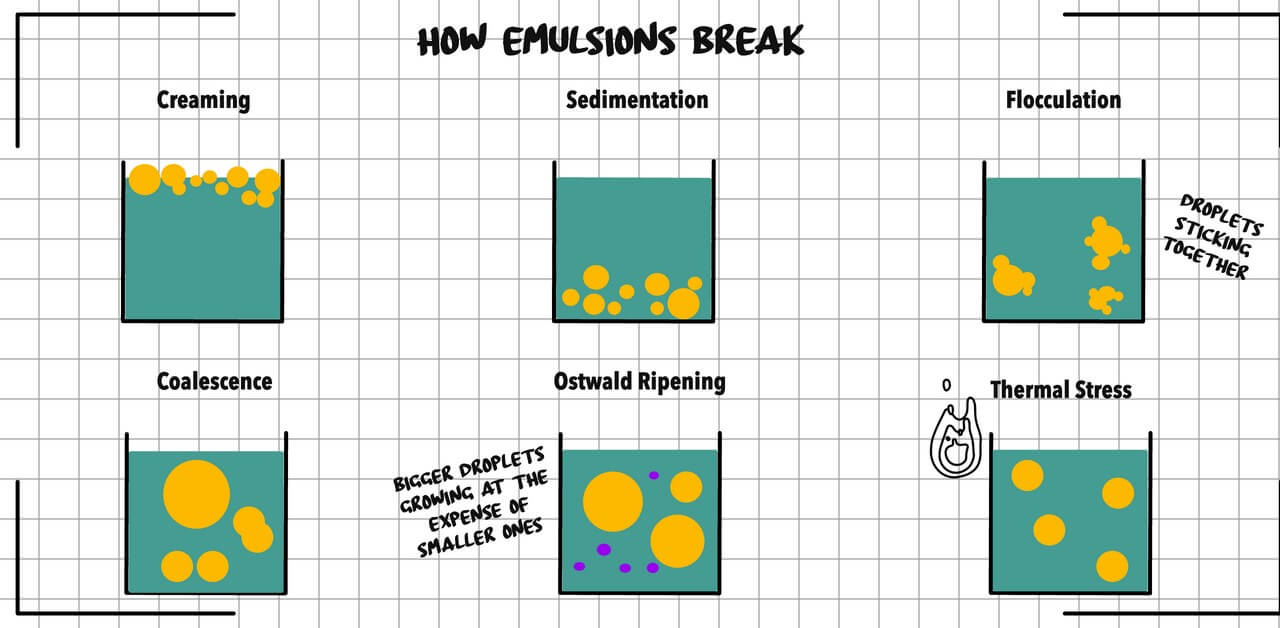
Summary Table: How Emulsions Break
| Process | Definition | Visible Result | Prevention Focus |
|---|---|---|---|
| Creaming / Sedimentation | Droplets rise or fall due to density difference | Layering or separation | Reduce droplet size, increase viscosity |
| Flocculation | Droplets cluster but remain separate | Cloudiness, aggregation | Charge stabilization, adequate emulsifier |
| Coalescence | Droplets merge into larger droplets | Phase separation | Strong interfacial film, controlled shear |
| Ostwald Ripening | Small droplets dissolve and grow larger ones | Gradual droplet coarsening | Uniform droplet size, low solubility phase |
| Mechanical / Thermal Stress | Damage from external forces or heat cycles | Foam, instability, inversion | Gentle handling, temperature control |
Comparing Emulsion Mixers: Types and Technologies
| Mixer Type | Typical Viscosity Range | Key Advantage(s) | Typical Applications |
|---|---|---|---|
| High-Shear | ~1 – 10, 000 mPa·s | Strong shear, flexible batch | Cosmetics, food emulsions, suspensions |
| Vacuum Emulsifier | ~1 – 100,000 mPa·s | Powder induction, low oxygen entrainment | Creams, lotions, adhesives, pastes |
| Homogeniser | Lower to mid viscosity | Very fine droplet size, high pressure | Pharmaceuticals, dairy homogenization |
| Continuous | Wide (depending on motor power) | Scalable, compact footprint | Large-volume continuous production |
Emulsion Mixers Comparison highlights:
- High shear mixers are versatile and widely used; good for both lab and production scale. View the X-Batch-Disperser
- Vacuum emulsifiers are essential when you need closed systems, powder induction, or minimal air entrainment. View the Conti TDS
- Homogenisers (sometimes ultrahigh pressure) can push droplet size lower, but at higher energy cost and often with limitations on viscosity and solids. View the Z inline mixer
- Inline systems shine when you want a compact footprint and continuous operation with steady flow. View the CoFlow
For users considering powder feeding and closed mixing, Conti-TDS Powder Induction System offers a specialized solution; see its details at Conti-TDS overview.
When comparing these systems, decision makers should look at shear force (s⁻¹), tip speed, flow consistency, ease of cleaning, and maintenance trade-offs.

Selecting the Right Emulsion Mixers for Your Process
Choosing the optimal emulsifier depends on multiple process parameters and constraints:
- Product viscosity / rheology: High-viscosity pastes may require vacuum induction or strong shear capability.
- Solids loading / particles: Systems that can handle solids without clogging (or allow robust powder induction) are needed.
- Batch vs continuous: For continuous production, inline or continuous rotor–stator systems may be preferred.
- Sanitation / cleaning: CIP (clean-in-place) capability, seal design, and hygienic construction matter, especially in food/pharma.
- Compliance / regulations: GMP, 3A, ATEX requirements may mandate particular designs/materials.
- Scale-up / lab to production: Ensure your lab-scale tests can scale reliably; small-batch systems differ in shear profile relative to production units. (See Small-Batch Mixers Compared).
You can develop a decision matrix mapping process parameters to candidate mixer types to guide initial screening.
Performance and ROI: What Results to Expect
To justify capital investment, engineers and management want quantifiable performance improvements. For example using the Conti TDS to produce emulsion paints resulted in:
- Throughput increase – 25 minutes to produce a 5 t batch with a solids content of over 70 %
- Additive reduction (less dispersing agent usage due to finer dispersion)
- Energy per kg (kWh or MJ per tonne). Up to 70 % less energy is used compared to traditional manufacturing methods
- Reduction in scrap / rework
- Payback period (often 6–24 months depending on scale and process improvements)
| Metric | Example Improvement |
|---|---|
| Batch time reduction | 40–80% faster |
| Additive saving | 10–25% less Dispersing agents |
| Energy per kg improvement | up to 70% lower |
| Payback period | 9–18 months typical |
You can also refer to Improve Industrial Mixer Efficiency for related performance strategies and case studies.
When you include a downloadable ROI calculator or worked example (based on your own data or representative metrics), users are more likely to stay engaged and trust the content.
Maintenance, Integration, and Operation
Once installed, the performance of your emulsifier depends on maintenance, cleanliness, and integration:
- CIP design & seal maintenance: use hygienic seals (e.g., mechanical, magnetic), plan for easy seal replacement, and ensure the mixer geometry is CIP-friendly.
- Wear parts & spares: rotor, stator, shaft bearings — plan spare parts to minimize downtime.
- Control & automation: integrate with PLC or SCADA, allow speed control, monitoring of torque and temperature.
- Installation & FAT (Factory Acceptance Testing): ensure alignment, vibration testing, and acceptance criteria.
- Scale-up considerations: small-batch units may differ in shear profile; ensure that your pilot units mimic industrial conditions. For guidance on small-scale comparators, see Small-Batch Mixers Compared
Proper planning here helps avoid costly retrofits or underperformance.
Common Mixing Issues and Troubleshooting Tips
Even with a good design, real-world systems often face problems. Here are common issues and fixes:
- Foaming / air entrainment: use vacuum degassing, antifoam agents, slow powder addition, or design a gas bleed.
- Fish eyes / unmixed pockets: increase shear, slow the feed rate, improve recirculation or use a multi-pass approach.
- Agglomeration / lumps: pre-wet powders, use staged addition, or use recirculation loops with bypass.
- Phase separation over time: ensure surfactant choice, droplet size control, and stability testing.
- Seal / leakage issues: monitor torque spikes, use robust mechanical seals or magnetic drives, ensure proper material compatibility.
For a deeper troubleshooting reference, you might consult technical journals or engineering guides in fields such as food processing or colloid chemistry.

Conclusion
Selecting the right emulsifying system is critical for product stability, efficiency, and consistency in industrial processes. Understanding emulsion formation, breakdown mechanisms, and practical equipment solutions allows engineers and operators to minimize failures, optimize production, and reduce material waste. High-shear and inline mixing technologies, coupled with proper process design, deliver reliable and scalable results across food, pharmaceutical, and chemical manufacturing.
Frequently Asked Questions

What is an emulsion?
An emulsion is a mixture of two immiscible liquids, like oil and water, where one is dispersed as droplets within the other using surfactants or mechanical mixing.
Why do emulsions break?
Emulsions break due to droplet instability caused by creaming/sedimentation, flocculation, coalescence, Ostwald ripening, or external mechanical and thermal stress.
How can high-shear mixing prevent emulsion breakdown?
High-shear mixing reduces droplet size, promotes uniform dispersion, and enhances emulsifier coverage, preventing coalescence and flocculation over time.
What is the difference between creaming and sedimentation?
Creaming occurs when lighter droplets rise to the surface; sedimentation happens when heavier droplets settle. Both are density-driven separation phenomena.
What is Ostwald ripening in emulsions?
Ostwald ripening is the process where smaller droplets dissolve and redeposit onto larger ones, increasing droplet size and contributing to eventual emulsion separation.
How does powder addition affect emulsion stability?
Incorrect or rapid powder addition can cause lumps, agglomeration, or “fish eyes,” leading to uneven droplet distribution and destabilization.
When should I use a vacuum powder induction system?
Vacuum systems, like Conti-TDS, are ideal for high-viscosity or high-solids emulsions to ensure rapid, uniform powder wetting and reduce air entrapment.
Can mechanical or thermal stress break emulsions?
Yes. Pumping, vibration, and temperature fluctuations can weaken interfacial films, accelerating coalescence and phase separation in sensitive emulsions.
How do I choose the right emulsifier?
Select emulsifiers based on HLB balance, droplet size targets, viscosity, and phase type (O/W vs W/O) to ensure long-term emulsion stability.
Are inline dispersers suitable for large-scale production?
Yes. Inline dispersers like the Ystral Z-Inline system provide consistent shear, scalable processing, and reduced batch times for industrial-scale emulsions.
References
McClements, D. J. Food Emulsions: Principles, Practices, and Techniques. 3rd Edition, CRC Press, 2015.
Tadros, T. Emulsion Formation and Stability. Wiley-VCH, 2013.
Jafari, S. M., Nano-Emulsions: Formation, Stability, and Applications in Food. Academic Press, 2017.
Further Reading and Research
Emulsion mixers: Recommended Articles and Websites
Articles:
- McClements, D. J., Food Emulsions: Principles, Practices, and Techniques. CRC Press, 2015.
- Tadros, T., Emulsion Formation and Stability. Wiley-VCH, 2013.
- Jafari, S. M., Nano-Emulsions: Formation, Stability, and Applications in Food. Academic Press, 2017.
Websites:
-
-
Detailed guides and technical insights on industrial mixing, emulsification, powder handling, and process optimization.
-
-
Food & Drug Administration (FDA) – www.fda.gov
-
Regulations and guidance on pharmaceutical and food emulsions, including GMP standards.
-
-
Institute of Food Technologists – www.ift.org
-
Research articles and best practices for emulsions, mixing, and food process engineering
-